How Much Cottage Cheese Is Too Much in a Day?
Quick Answer: For most healthy people, one to two servings a day - roughly 200 to 400g - is a sensible range and easily accommodated. The limiting factor is usually sodium rather than protein: cottage cheese can carry a meaningful amount per serving, and three large servings can account for a substantial share of a day’s recommended sodium intake. Watch total sodium, keep variety in your protein sources, and be more cautious if you’re managing blood pressure, kidney issues, or lactose sensitivity.
It went from a diet food nobody wanted to the thing people eat at every meal. Somewhere in that shift, portion sense got lost.

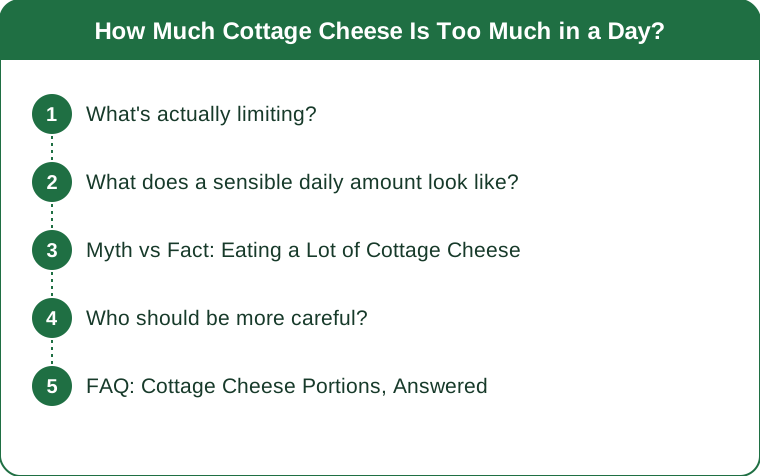
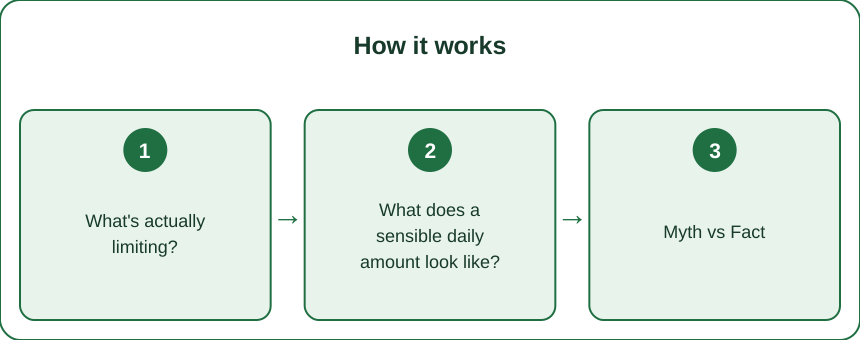
What’s actually limiting?
Sodium is the first ceiling most people hit. Salt is used in cottage cheese production and content varies considerably between brands. A large serving can contribute a noticeable fraction of the commonly recommended daily sodium limit, and three servings can take a serious bite out of it.
Protein isn’t usually the limiter for healthy people. Higher protein intakes are generally well tolerated by people with normal kidney function, and cottage cheese would be an inefficient way to reach an excessive intake anyway.
Lactose tolerance varies and matters. Cottage cheese contains less lactose than milk but more than aged hard cheeses. People who tolerate one serving comfortably may find three produce bloating and digestive discomfort.
Calcium adds up faster than people expect. Dairy is calcium-dense, and very high total intake across supplements plus multiple dairy servings isn’t beneficial. Food sources alone rarely cause a problem, but supplements plus heavy dairy can.
Displacement is the quiet cost. Three tubs a day is three meals not eaten as something else, and dietary variety delivers nutrients that no single food provides. A monotonous diet is a real downside even when the food is a good one.
And satiety cuts both ways. Cottage cheese is very filling, which is useful for appetite management and less useful if it’s crowding out foods you actually need.
What does a sensible daily amount look like?
One to two servings, roughly 100 to 200g each. That’s a substantial protein contribution while leaving room in your sodium budget and your plate for other foods.
Check the label rather than assuming. Sodium per 100g varies substantially between brands and between regular and low-sodium versions. Two brands that look identical can differ considerably.
Look for reduced-sodium versions if you eat it daily. They exist, they’re widely available, and they change the calculation entirely for anyone eating it more than once a day.
Spread protein across the day rather than concentrating it. Distributing protein across meals is generally considered more effective for muscle protein synthesis than loading it into one enormous serving.
Rotate with other protein sources. Greek yoghurt, skyr, eggs, fish, legumes, tofu. Variety covers nutritional gaps and prevents the flavour fatigue that ends most food habits.
And account for other sodium in your day. Bread, processed meats, sauces, and packaged food all contribute. Cottage cheese in an otherwise low-sodium diet is a different proposition from cottage cheese alongside a lot of packaged food.

Myth vs Fact: Eating a Lot of Cottage Cheese
Myth: You can’t overdo a healthy food. Fact: quantity matters for anything. Sodium load, digestive tolerance, and dietary variety are all real considerations regardless of how good the food is.
Myth: High protein damages your kidneys. Fact: in people with normal kidney function, higher protein intakes are generally well tolerated. People with existing kidney disease are a different case and should follow clinical advice.
Myth: Cottage cheese before bed is essential for muscle. Fact: it contains casein, which digests slowly, and the pre-sleep protein idea has some support - but total daily protein intake matters far more than the timing of any single serving.
Myth: Low-fat is automatically the better choice. Fact: full-fat versions are more satiating for some people and the fat content is modest either way. The better choice is whichever you’ll actually eat consistently.
Myth: The liquid in the tub means it’s gone off. Fact: that’s whey separating, which is normal. Smell and appearance are the useful indicators, not the presence of liquid.
Myth: It’s the highest-protein dairy option. Fact: it’s excellent, but skyr and some Greek yoghurts are comparable or higher per serving depending on the product. Comparing labels beats assuming.
Who should be more careful?
Anyone managing blood pressure. Sodium is the main reason to pay attention here, and if you’ve been advised to reduce salt intake, several servings a day of a moderately salty food is worth reviewing.
People with kidney disease. Both protein and sodium intake are commonly managed in kidney disease, and that’s a case for individual clinical advice rather than general guidance.
People with lactose sensitivity. Tolerance is dose-dependent, so an amount that’s fine once a day may not be fine three times. Lactose-free options exist.
Anyone with a dairy allergy. Distinct from lactose intolerance and not a dose question - this is avoidance rather than moderation.
People taking calcium supplements. Heavy dairy plus supplements can push total calcium intake higher than intended. Worth checking the total rather than each source separately.
And anyone whose diet has narrowed a lot. This is general information, not medical advice. If your eating has become very restricted around a small number of foods, that’s worth raising with a GP or dietitian - the food isn’t the issue, the narrowing is.
FAQ: Cottage Cheese Portions, Answered
How much cottage cheese can I eat in a day?
For most healthy people, one to two servings of around 100 to 200g each is a sensible range. The usual limiting factor is sodium rather than protein, so check the label if you’re eating it daily.
Is cottage cheese high in sodium?
It can be, and content varies substantially between brands. A large serving contributes a meaningful share of a day’s recommended sodium, which is why reduced-sodium versions are worth looking for if you eat it often.
Can too much protein hurt your kidneys?
In people with normal kidney function, higher protein intakes are generally well tolerated. Existing kidney disease is a different situation requiring individual clinical advice.
Is cottage cheese good before bed?
It contains casein, which digests slowly, and pre-sleep protein has some supporting evidence. But total daily protein intake matters considerably more than the timing of one serving.
TL;DR:
- One to two servings a day, around 100 to 200g each, suits most healthy people comfortably.
- Sodium is usually the limiting factor, not protein - and it varies substantially between brands, so read the label.
- Look for reduced-sodium versions if you eat it daily, and account for the rest of your day’s sodium.
- Lactose tolerance is dose-dependent; an amount that’s fine once may not be fine three times.
- Rotate protein sources for variety, and be more careful if you’re managing blood pressure or kidney issues.
The separated liquid is whey, not spoilage. The sodium on the label is the number actually worth checking.
Keep Reading
This article is for general informational purposes only and is not medical advice. Always consult a qualified health professional for guidance specific to you.