Is Cottage Cheese Before Bed Actually Worth It?
Quick Answer: Cottage cheese is roughly 80 percent casein, which forms a gel in the stomach and releases amino acids slowly over several hours - so it genuinely does provide a longer overnight supply than whey or a light snack. Research on pre-sleep protein has found that around 30 to 40 grams before bed increases overnight muscle protein synthesis and, over training programmes, supports strength and muscle gains. The catch: this matters most if your total daily protein is low or unevenly distributed. If you already hit your daily target across three good meals, a bedtime bowl adds relatively little. A standard 200g serving gives around 22 to 25 grams of protein, so most people need a slightly larger portion than they think.
It is one of the few gym habits from the 1990s that turned out to be substantially correct.

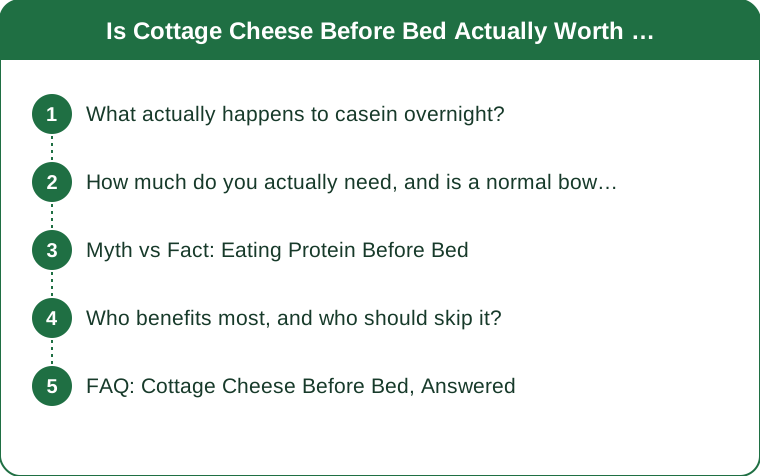
What actually happens to casein overnight?
Dairy protein is about 80 percent casein and 20 percent whey, and cottage cheese is largely the casein fraction - the whey is drained off during production. That composition is the whole reason this works.
Casein clots in the stomach. In the acidic environment of the stomach, casein forms a semi-solid gel. That gel empties slowly into the small intestine, so amino acid absorption is spread out over hours rather than arriving in a spike.
Whey does the opposite. It stays liquid, empties fast, and produces a rapid, high peak in blood amino acids that falls away within about 90 minutes.
Measured, the difference is substantial. Studies comparing the two have found casein producing elevated blood amino acid levels for around 7 hours, versus roughly 90 minutes to 2 hours for whey. Overnight, that is close to full coverage.
Why overnight coverage matters at all. You are fasting for 7 to 9 hours. During that window, muscle protein breakdown continues while synthesis has little to work with. Research using pre-sleep protein has shown that protein consumed before bed is properly digested and absorbed during sleep - which was not obvious and had to be demonstrated - and that it increases overnight muscle protein synthesis rates compared with a placebo.
Over longer periods, training studies combining resistance exercise with pre-sleep protein have generally reported greater gains in muscle size and strength than training with the same daily protein consumed without the bedtime dose - though not every study agrees, and the effect is modest rather than dramatic.
The most important caveat, stated plainly: in several of these studies, the pre-sleep protein also raised total daily protein intake. It is genuinely difficult to separate the benefit of the timing from the benefit of simply eating more protein - and when total intake is matched, the advantage of the bedtime dose shrinks considerably.
How much do you actually need, and is a normal bowl enough?
The studied dose is 30 to 40 grams of protein, and this is where most people fall short without realising.
Cottage cheese protein by portion, using typical values for a plain low or medium fat product at roughly 11 to 12 grams of protein per 100g:
- 100g - around 11 to 12g protein. Not enough on its own.
- 150g - around 17g. Still short.
- 200g, a standard small tub - around 22 to 25g. Close, and adequate for many people.
- 250 to 300g - around 28 to 36g. This is the range the research uses.
Brands vary meaningfully. Some higher-protein versions reach 13 to 14 grams per 100g. Check the label rather than assuming - the difference between two products can be 25 percent.
Easy ways to top it up without eating an enormous bowl:
- A tablespoon of skyr or Greek yogurt stirred through adds a few grams and loosens the texture.
- A scoop of casein powder blended in, if you genuinely want the full 40g.
- Seeds - pumpkin seeds add a little protein plus magnesium.
- A boiled egg alongside, if savoury suits you better.
Fat content changes very little here. Full-fat cottage cheese has slightly less protein per 100g and considerably more calories; low-fat has more protein per calorie. Neither meaningfully changes the digestion rate, which is driven by the casein structure.
One practical point: sodium. Cottage cheese is comparatively high in salt - often 300 to 400mg per 100g. A 300g bedtime portion is a substantial sodium load, which matters if you are watching intake for blood pressure. Lower-sodium versions exist and are worth seeking out if you eat it daily.

Myth vs Fact: Eating Protein Before Bed
Myth: Eating before bed makes you gain fat. Fact: Total daily energy intake determines fat gain, not the clock. Studies of pre-sleep protein specifically have not found fat gain when it fits within daily needs. What does cause weight gain is adding a 400-calorie bowl on top of an already adequate day - which is about the calories, not the timing.
Myth: Your metabolism shuts down while you sleep. Fact: Resting metabolic rate drops modestly during sleep but digestion, absorption, and protein synthesis all continue. The research demonstrating overnight absorption of pre-sleep protein settled this directly.
Myth: You need casein specifically or it does not work. Fact: Casein has the most favourable release profile, but any substantial protein source before bed provides amino acids overnight. A chicken breast or eggs work; they just digest somewhat differently. Whey is the least ideal for this purpose and still better than nothing.
Myth: It will disrupt your sleep. Fact: For most people, a moderate protein snack does not impair sleep, and some evidence suggests dairy may mildly support it. A large, high-fat, or spicy meal close to bedtime is a different matter and does commonly disrupt sleep, particularly with reflux.
Myth: This is only for bodybuilders. Fact: The strongest practical case is actually for older adults, who experience anabolic resistance - requiring more protein per meal to trigger the same response - and who frequently eat most of their protein at one meal. Even distribution across the day, including before bed, is a reasonable strategy for maintaining muscle with age.
Who benefits most, and who should skip it?
Most likely to benefit:
- Anyone under-eating protein overall. If your daily total is well below roughly 1.6g per kg of bodyweight and you are training, adding a bedtime portion is a straightforward fix.
- People whose protein is bunched into one meal. A day with 10g at breakfast, 15g at lunch, and 70g at dinner is common and suboptimal. Spreading it out, including before bed, is likely more useful than the bedtime dose specifically.
- Those training in the evening, where the pre-sleep dose extends the post-workout supply window.
- Older adults maintaining muscle mass, for the reasons above.
- Anyone in a calorie deficit trying to preserve muscle, where protein distribution matters more than it does at maintenance.
Unlikely to notice much:
- Anyone already eating 30 to 40 grams of protein at three or four meals. You are covered, and the marginal return is small.
- People not doing resistance training. The mechanism relies on there being a training stimulus to support.
Reasons to skip it:
- Lactose intolerance, though cottage cheese is comparatively low in lactose and many people tolerate it. Symptoms will tell you.
- Reflux. Eating close to lying down aggravates it for some people, and a 2 to 3 hour gap is the standard advice.
- If it pushes you over your calorie needs without a good reason.
- If you simply do not enjoy it. Adherence beats optimisation every time, and skyr, Greek yogurt, or a small serving of any protein food does a similar job.
Timing within the evening: roughly 30 to 90 minutes before sleeping. Immediately before lying down increases the odds of reflux; three hours earlier and it is really just a late snack rather than a pre-sleep dose.
This is general information, not medical advice. If you have kidney disease or have been advised to limit protein or sodium, follow that guidance.
FAQ: Cottage Cheese Before Bed, Answered
Does it have to be cottage cheese?
No. Greek yogurt, skyr, quark, or a casein shake all provide a similar slow-release profile. Cottage cheese happens to be cheap, high in casein, and available everywhere.
Will it help me sleep?
Dairy contains tryptophan, and there is a longstanding idea that it aids sleep, but the amounts and the mechanism make a large effect unlikely. Any benefit is more plausibly from not going to bed hungry.
Is 200g every night too much dairy?
For most people, no. Sodium is the more relevant consideration than the dairy itself if you eat it daily - check the label and consider a reduced-salt version.
Can I have it if I am trying to lose weight?
Yes, and it is a reasonable choice - high protein, high satiety, moderate calories. It just has to fit within your daily intake rather than being added on top of it.
What can I add without ruining the point?
Berries, cinnamon, a few seeds, or a small amount of nut butter. What undermines it is a large addition of sugar or fat that turns a 150-calorie snack into a 450-calorie dessert.
TL;DR:
- Cottage cheese is mostly casein, which gels in the stomach and releases amino acids for around 7 hours - genuinely useful overnight coverage.
- The studied dose is 30 to 40g of protein, which is roughly 250 to 300g of cottage cheese - more than most people serve themselves.
- The benefit is largest if your total daily protein is low or bunched into one meal. If you already hit your target across three meals, the marginal gain is small.
- Eating before bed does not cause fat gain - total daily calories do. Timing is not the variable.
- Watch the sodium if you eat it nightly, and leave 30 to 90 minutes before lying down if you get reflux.
It is a good habit that was oversold. Fix your daily total first, and then use the bedtime bowl to smooth out the distribution.
Keep Reading
This article is for general informational purposes only and is not medical advice. Always consult a qualified health professional for guidance specific to you.