Cottage Cheese in a Lunchbox: What Actually Keeps It Safe
Quick Answer: Cottage cheese needs to stay below 40F, and food safety guidance gives perishable dairy a 2-hour limit in the danger zone - 1 hour above 90F. A standard insulated lunch bag with two frozen gel packs, packed cold, reliably holds a container under 40F for 4 to 5 hours. Without ice packs, an insulated bag alone is not enough for a lunch eaten at noon.
Cottage cheese is having a genuine moment as a packed protein, and back-to-school season is exactly when the safety question stops being theoretical.

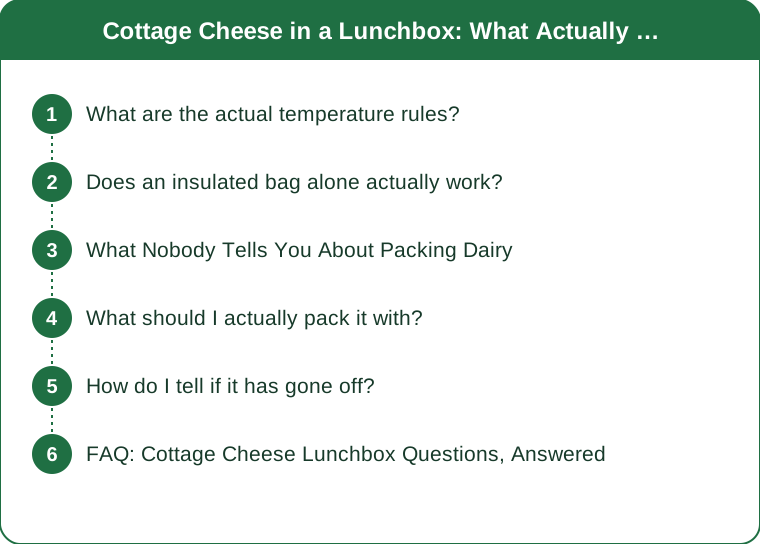
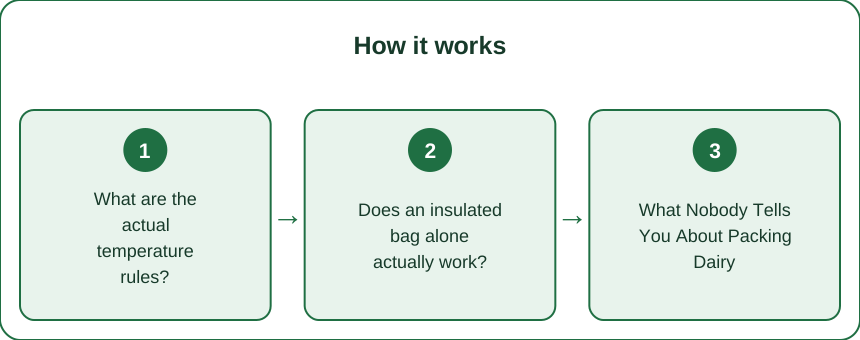
What are the actual temperature rules?
The relevant framework is the danger zone: 40F to 140F, where bacterial growth is fastest.
USDA guidance for perishable foods is straightforward: no more than 2 hours in the danger zone, or 1 hour if the ambient temperature is above 90F. After that, the recommendation is to discard rather than to judge by smell or taste.
Cottage cheese sits at the more vulnerable end of dairy. It is a high-moisture, relatively low-acid fresh cheese with a pH typically around 4.5 to 5.0, which does not provide the protective acidity of, say, yogurt at 4.0 to 4.5.
The practical takeaway: this is not a food where you can rely on it looking fine. Bacterial growth sufficient to cause illness occurs well before there is any visible or olfactory change.
If that sounds alarming, it is worth putting in context - a properly packed insulated bag solves the problem completely, and it costs almost nothing.
Does an insulated bag alone actually work?
Not for a full morning, no. This is the part most people get wrong.
An insulated lunch bag slows heat transfer but does not remove heat. Starting at refrigerator temperature - about 38F - a container in an insulated bag at room temperature will typically cross 40F within roughly 60 to 90 minutes, depending on the bag, the container, and the ambient temperature.
Adding two frozen gel packs changes the picture entirely. They provide active cooling as they thaw, and testing consistently shows insulated bags with two packs holding contents below 40F for 4 to 6 hours at normal room temperature.
Placement matters more than people expect. Put one pack under the container and one on top, since cold air falls. A single pack sitting beside the container is meaningfully less effective than the same pack sitting on top of it.
A frozen water bottle works as a substitute and doubles as a drink once it thaws, though it warms faster than a purpose-made gel pack of similar size.
What Nobody Tells You About Packing Dairy
Four practical things that do not show up in general food safety advice.
Pre-chill the bag. An insulated bag stored in a warm kitchen starts at room temperature and spends the first stretch of the morning warming your food before the ice packs win. Storing the bag in the fridge overnight, or putting the gel packs in it 20 minutes before packing, makes a measurable difference.
A full container performs better than a half-empty one. More thermal mass means slower temperature change. If you are packing a small portion, a smaller container is better than a large one with air in it.
Do not pack cottage cheese warm-adjacent. A thermos of hot soup in the same bag is actively working against your ice packs. Hot and cold items need separate bags.
A locker is not a fridge but a backpack is worse. A backpack in a warm car or a sunny classroom can reach well above room temperature. If there is a fridge available, use it, and if not, the bag becomes the whole system.
That first point is the one that costs nothing and helps most.

What should I actually pack it with?
Cottage cheese is roughly 12 to 14 grams of protein per half cup, which makes it one of the more efficient packed proteins available. Building around it is easy.
Savory: cottage cheese with cracked black pepper, cherry tomatoes, and cucumber, with crackers packed separately so they stay crisp. Everything bagel seasoning is the reliable upgrade.
Sweet: cottage cheese with berries and a small amount of honey, plus granola in a separate container. Adding granola in the morning means soggy granola by noon.
Higher protein: cottage cheese blended smooth with a spoon of nut butter and cocoa, which travels well and reads as a dessert.
With eggs: hard-boiled eggs and cottage cheese together push a lunch past 25 grams of protein, which is the range associated with better satiety through the afternoon.
One texture note: cottage cheese separates as it sits. A little liquid pooling on top is normal and not a spoilage sign - stir it back in. Draining it before packing produces a firmer result that some people prefer.
How do I tell if it has gone off?
Trust the timeline over the senses, but know the signs anyway.
Spoiled cottage cheese typically develops a sour or yeasty smell distinct from its normal mild tang, a yellowing color, a noticeably slimy texture, or visible mold. Any of those means discard the whole container - mold in soft high-moisture cheese can have threads well beyond the visible spot, so scooping out the affected area is not sufficient the way it can be with hard cheese.
But the important point stands: food that has been in the danger zone too long can be unsafe with no sensory change at all. That is why the 2-hour rule exists as a rule rather than a suggestion.
Unopened, cottage cheese generally keeps to its printed date. Opened, most manufacturers suggest 5 to 7 days refrigerated. Storing the container upside down slows spoilage by reducing the air contact at the surface - a small trick that genuinely works.
When in doubt, discard it. This is general information, not medical advice.
FAQ: Cottage Cheese Lunchbox Questions, Answered
Can I freeze cottage cheese to pack it?
You can, and it stays safe, but the texture becomes grainy and watery on thawing. Frozen cottage cheese works fine for cooking or blending into a smoothie later; it is not pleasant eaten straight.
How long does it last once opened?
Most manufacturers indicate 5 to 7 days refrigerated at or below 40F. Storing the container upside down helps a little.
Is single-serve packaging worth it?
For lunches, often yes - a sealed single-serve container has not been opened and exposed, so it starts from a better place than a scoop from a tub opened four days ago.
TL;DR:
- Keep cottage cheese below 40F. Perishable dairy gets 2 hours in the danger zone, 1 hour above 90F.
- An insulated bag alone crosses 40F in about 60 to 90 minutes. Two frozen gel packs hold it 4 to 6 hours.
- Put one pack under the container and one on top - cold air falls.
- Pre-chill the bag, use a container that is full rather than half empty, and keep hot items in a separate bag.
- Liquid separating on top is normal. Sour smell, yellowing, slime, or mold means discard the whole container.
- Spoilage can occur with no sensory change, which is why the time rule matters more than the sniff test.
With school lunches restarting, two gel packs and a pre-chilled bag turns cottage cheese from a risky pack into one of the best proteins in the box. This is general information, not medical advice.
Keep Reading
This article is for general informational purposes only and is not medical advice. Always consult a qualified health professional for guidance specific to you.