Can You Eat Cottage Cheese If You're Lactose Intolerant? The Real Answer
Quick Answer: Cottage cheese contains less lactose than milk but more than aged hard cheeses, so many people with mild lactose intolerance tolerate a small serving reasonably well, while those with more significant intolerance may still experience symptoms — individual tolerance varies enough that testing a small amount is the most reliable way to know.
Cottage cheese sits in an awkward middle ground on the lactose spectrum — not lactose-free like some assume, but not as high as a glass of milk either.

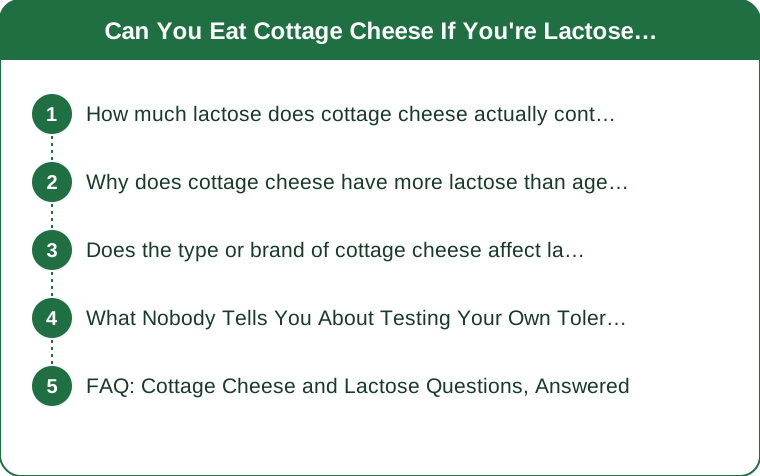
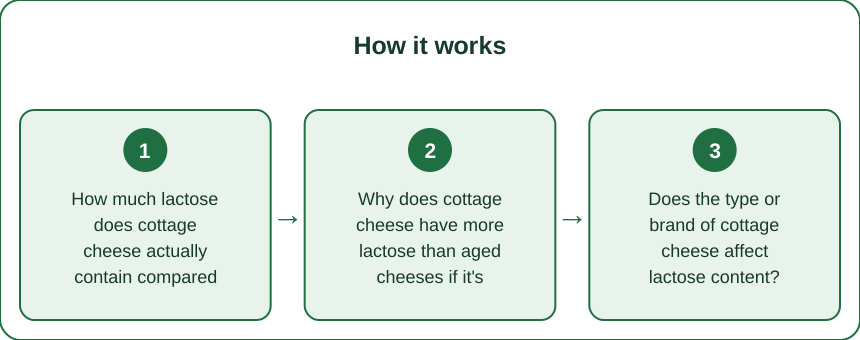
How much lactose does cottage cheese actually contain compared to other dairy?
A typical serving of cottage cheese contains roughly 3-4 grams of lactose, compared to about 12-13 grams in a cup of milk and often under 1 gram in well-aged hard cheeses like cheddar or parmesan. This puts cottage cheese in a middle position — lower than milk, but higher than aged cheeses.
Why does cottage cheese have more lactose than aged cheeses if it’s still a dairy product?
Aged, hard cheeses lose much of their lactose during the fermentation and aging process, as bacteria consume the lactose over time. Cottage cheese is a fresh, unaged cheese, meaning it hasn’t gone through that same extended lactose-reducing process, leaving more lactose intact compared to a cheese aged for months.

Does the type or brand of cottage cheese affect lactose content?
Some brands offer lactose-free cottage cheese specifically, made by adding lactase enzyme during production to break down the lactose — these can be a good option for people who react even to cottage cheese’s naturally lower lactose content, providing the same protein benefits without the digestive issue.
What Nobody Tells You About Testing Your Own Tolerance
Here’s what’s often skipped in general dairy-and-lactose advice: lactose intolerance exists on a real spectrum, not as a simple yes/no. Many people who react strongly to a glass of milk tolerate a modest serving of cottage cheese without issue, precisely because of its lower lactose content — the only reliable way to know your own tolerance is testing a small serving (not a full portion) and observing how you feel over the following hours, rather than assuming based on your reaction to other dairy products.
FAQ: Cottage Cheese and Lactose Questions, Answered
Does taking a lactase enzyme supplement help with cottage cheese specifically?
Yes — over-the-counter lactase supplements, taken with the meal, can help many people with lactose intolerance tolerate cottage cheese and other dairy products they’d otherwise react to.
Is Greek yogurt a better or worse choice than cottage cheese for lactose intolerance?
Greek yogurt often has slightly lower lactose than cottage cheese due to its straining and fermentation process, though both are generally more tolerable than milk — individual tolerance still varies.
Should someone with a diagnosed dairy allergy (not just intolerance) still consider trying cottage cheese?
No — a true dairy allergy (an immune response, distinct from lactose intolerance, which is a digestive enzyme issue) requires avoiding all dairy products entirely, including cottage cheese, regardless of lactose content. This is general information, not medical advice.
TL;DR:
- Cottage cheese has less lactose than milk but more than aged hard cheeses
- Fresh, unaged cheeses retain more lactose than cheeses that have gone through extended aging
- Lactose-free cottage cheese options exist for those who react even to the naturally lower amount
- Testing a small serving is the most reliable way to gauge your own personal tolerance
This is general information, not medical advice — a true dairy allergy is different from lactose intolerance and needs full avoidance regardless of lactose content.
Keep Reading
This article is for general informational purposes only and is not medical advice. Always consult a qualified health professional for guidance specific to you.