How Much Protein Is Actually in Cottage Cheese? Reading the Tub Properly
Quick Answer: Cottage cheese typically provides around 11 to 14 grams of protein per 100 grams, meaning a standard 200 gram serving delivers roughly 22 to 28 grams. Lower-fat versions are slightly higher in protein per 100 grams because fat has been removed rather than protein added, and the difference between brands is large enough to be worth checking rather than assuming.
It has become the default high-protein food of the moment, and the numbers are good - just not identical across the shelf.

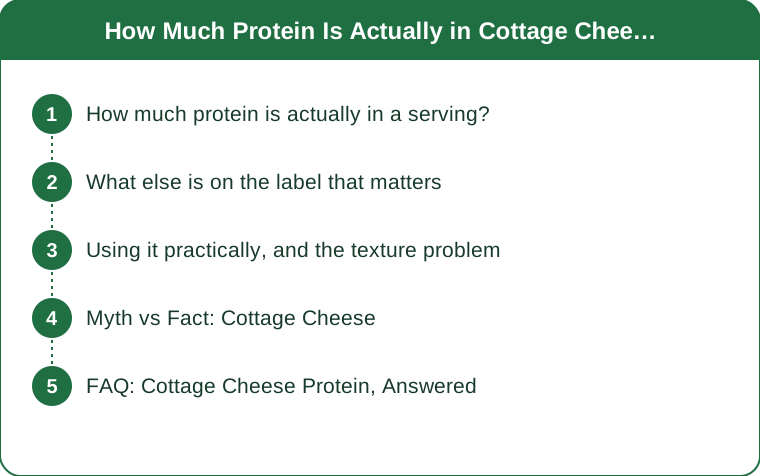
How much protein is actually in a serving?
It depends on the fat percentage and the brand, and the range is wider than you would expect.
Typical values per 100 grams:
- Fat-free or 0 percent: roughly 12 to 14 grams of protein
- Low-fat, around 2 percent: roughly 11 to 13 grams
- Full-fat, around 4 to 5 percent: roughly 10 to 12 grams
Why the lower-fat versions read higher: removing fat concentrates everything else per unit of weight. No extra protein has been added - the denominator has changed. In absolute terms across a full tub, the difference is modest.
What a realistic serving delivers:
- A 200 gram serving at 12 grams per 100 gives 24 grams of protein
- A 250 gram tub gives around 30 grams
- A 100 gram side portion gives around 12 grams, which is a useful addition rather than a protein meal
How it compares to the obvious alternatives, per 100 grams:
- Cottage cheese: roughly 11 to 14 grams
- Greek yoghurt (strained, 0 percent): roughly 9 to 11 grams
- Skyr: roughly 11 to 12 grams
- Quark: roughly 12 to 14 grams
So cottage cheese and quark sit at the top of that group, with skyr close behind and Greek yoghurt slightly lower. All are good sources; the differences are smaller than marketing implies.
The one number worth checking on the tub: protein per 100 grams, not per serving. Serving sizes vary between brands and comparing per-serving figures across products is how people end up misjudging.
What else is on the label that matters
Protein is not the only figure that varies, and two others are worth a glance.
Sodium. Cottage cheese is a salted product and sodium content varies substantially between brands - often in the range of 300 to 400 milligrams per 100 grams, which for a 200 gram serving is a meaningful share of a daily intake target.
- Low-sodium versions exist and taste noticeably milder
- Relevant for anyone monitoring blood pressure - worth discussing with a healthcare professional if that applies to you
Added ingredients. Basic cottage cheese is milk, cream, salt and cultures. Some products add:
- Stabilisers and thickeners - modified starch, guar gum, carrageenan - which affect texture rather than nutrition
- Added sugar in flavoured versions, sometimes substantially. A fruit-flavoured pot can contain as much sugar as a dessert yoghurt.
- Preservatives, in longer-life products
Casein versus whey. Cottage cheese protein is predominantly casein, which digests more slowly than whey.
- This is why it is frequently recommended before bed - the slow release provides a more sustained amino acid supply overnight
- The practical difference is modest for most people. Total daily protein matters considerably more than timing, and the overnight-casein research shows benefits that are real but not dramatic.
Calcium. A 200 gram serving provides a useful contribution toward daily calcium needs, though less than the same weight of hard cheese or milk. Worth noting for anyone tracking calcium intake, particularly postmenopausal women.
Lactose. Cottage cheese contains less lactose than milk but more than aged hard cheeses. People with lactose intolerance vary in what they tolerate - this is general information, not medical advice.

Using it practically, and the texture problem
The main barrier to eating cottage cheese regularly is texture, and it is easily solved.
Blending changes everything. Thirty seconds in a blender or with a stick blender turns cottage cheese into a smooth, thick, neutral base. This single step converts it from a food people tolerate into an ingredient, and most people who dislike cottage cheese dislike the curds rather than the taste.
What blended cottage cheese works as:
- A yoghurt substitute with more protein and less sugar
- A base for savoury dips, with herbs, garlic and lemon
- A pasta sauce base, blended with a little pasta water and parmesan
- A ricotta substitute in baked dishes, at a considerably lower fat content
- A smoothie addition, adding around 12 grams of protein per 100 grams without a protein powder
Unblended savoury uses that suit cooler weather:
- On hot toast with black pepper and olive oil, which is the simplest and best of them
- Stirred through warm grains - the residual heat softens it slightly
- Topped with roasted vegetables, where the temperature contrast works
- Folded into scrambled eggs at the end of cooking, which adds protein and keeps them soft
A note on heating: cottage cheese splits if heated aggressively, because the curds separate. Add it at the end, off the heat, or blend it first if it is going into something hot.
Where it fits in a day:
- Breakfast is where it displaces lower-protein options most effectively
- Before bed, if you find eating late suits you
- As a component rather than a meal. 200 grams plus fruit and nuts is a genuinely balanced breakfast; 200 grams on its own is a snack.
On the general protein point: most adults benefit from more protein than they typically eat, particularly with age, and spreading it across meals rather than concentrating it at dinner. Cottage cheese is a convenient and inexpensive way to raise breakfast protein, which is where most people’s intake is lowest.
Myth vs Fact: Cottage Cheese
Myth: Full-fat cottage cheese has much less protein. Fact: the difference is a couple of grams per 100. Removing fat concentrates the protein per unit weight, but no protein has been added to the low-fat version, and across a whole tub the gap is small.
Myth: It is a complete replacement for Greek yoghurt. Fact: nutritionally similar, with cottage cheese slightly higher in protein and substantially higher in sodium. The sodium difference is the one people miss and it is worth checking if you are watching intake.
Myth: Eating casein before bed is essential for muscle gain. Fact: pre-sleep protein has some supporting research, but total daily protein is by far the larger factor. The overnight timing is an optimisation, not a requirement.
Myth: Flavoured versions are a healthy choice by default. Fact: some contain as much added sugar as a dessert yoghurt. Plain plus your own fruit gives you the same result with control over the sugar.
Myth: You cannot cook with it. Fact: you can, with one rule - blend it or add it off the heat. Aggressive heating splits the curds. Blended, it works as a ricotta substitute and as a pasta sauce base very effectively.
FAQ: Cottage Cheese Protein, Answered
How much protein is in a standard serving?
Roughly 22 to 28 grams in a 200 gram serving, depending on brand and fat content. Check protein per 100 grams rather than per serving, since serving sizes vary between brands.
Is low-fat higher in protein?
Slightly, per 100 grams, because removing fat concentrates everything else. No extra protein has been added, and the absolute difference across a tub is modest.
Cottage cheese or Greek yoghurt?
Cottage cheese is usually a little higher in protein and considerably higher in sodium. Both are good sources - the sodium difference is the practical one to consider.
Why does it split when I cook with it?
Heat separates the curds. Blend it first, or add it at the end off the heat, and it behaves like a smooth thick cream.
Is it worth eating before bed?
Its protein is mostly casein, which digests slowly, and pre-sleep protein has some research support. It is a reasonable habit but total daily protein matters far more. This is general information, not medical advice.
TL;DR:
- Roughly 11 to 14 grams of protein per 100 grams, so a 200 gram serving gives 22 to 28 grams
- Low-fat versions read higher because fat was removed, not because protein was added
- Sodium varies substantially between brands and is the figure most people never check
- Blending for 30 seconds turns it into a neutral base and solves the texture objection entirely
- Best used at breakfast, where most people’s protein intake is lowest
Check protein per 100 grams and the sodium line, blend the tub, and it becomes one of the cheapest ways to add 25 grams of protein to a morning.
Keep Reading
This article is for general informational purposes only and is not medical advice. Always consult a qualified health professional for guidance specific to you.