The Cottage Cheese Smoothie: Why It Actually Works Better Than It Sounds
Quick Answer: Blended thoroughly with fruit and a liquid base, cottage cheese loses its characteristic curd texture almost entirely and adds significant protein (roughly 12-14 grams per half cup) with a mild flavor that blends into most fruit smoothie combinations without tasting distinctly like cottage cheese — the key is blending long enough to fully smooth it out, not the ingredient itself being a poor smoothie fit.
Cottage cheese in a smoothie sounds like it should taste or feel wrong, but the actual result, when made correctly, is closer to a thick, protein-boosted milkshake than anything resembling cottage cheese’s usual curdy texture.

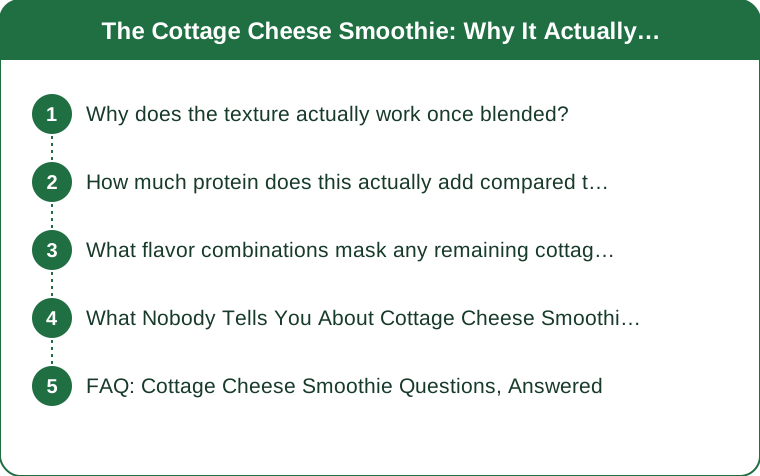
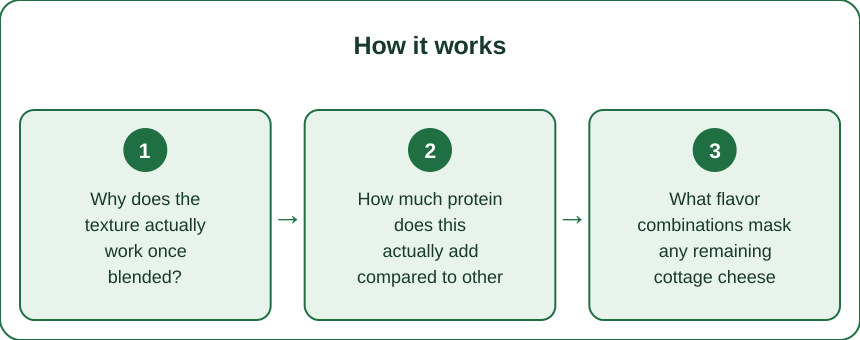
Why does the texture actually work once blended?
A high-powered blender run for a full 45-60 seconds (longer than many people initially blend for) fully breaks down cottage cheese’s curds into a smooth, uniform texture, similar to how Greek yogurt smooths out when blended — under-blending is the most common reason people report a lingering curd texture and assume the ingredient just doesn’t work.
How much protein does this actually add compared to other smoothie boosters?
A half cup of cottage cheese adds roughly 12-14 grams of protein, comparable to a scoop of protein powder, but with the added benefit of contributing real food texture and creaminess rather than the sometimes chalky or overly sweet quality some protein powders bring to a smoothie.

What flavor combinations mask any remaining cottage cheese taste most effectively?
Berries, banana, and vanilla-forward combinations mask any residual flavor most effectively, since their natural sweetness and stronger flavor profile dominate over cottage cheese’s mild, slightly tangy taste — citrus and very light fruit combinations tend to let more of the underlying flavor come through, so they’re a less forgiving starting point for first-time trials.
What Nobody Tells You About Cottage Cheese Smoothie Texture Fails
The most common reason a cottage cheese smoothie turns out gritty rather than smooth isn’t the ingredient — it’s using a low-powered blender or stopping too early; a full-power blend for a longer stretch than a typical fruit-only smoothie fixes nearly every texture complaint people have about this specific combination.
FAQ: Cottage Cheese Smoothie Questions, Answered
Does cottage cheese change the smoothie’s consistency beyond texture?
Yes — it adds thickness and creaminess similar to adding Greek yogurt, which many people find makes the smoothie feel more like a milkshake and more satisfying than a thinner fruit-only version.
Should I use full-fat or low-fat cottage cheese for smoothies?
Either works texturally once fully blended; the choice mostly comes down to personal preference for overall calorie and fat content rather than any smoothie-specific performance difference.
Can I make a cottage cheese smoothie ahead of time and store it?
It’s best consumed shortly after blending, since the texture can separate somewhat after sitting in the fridge for an extended period — a quick re-blend or shake before drinking usually restores it well enough.
TL;DR:
- Full blending (45-60 seconds) fully smooths out cottage cheese’s curd texture
- Half a cup adds roughly 12-14 grams of protein, comparable to a scoop of protein powder
- Berry, banana, and vanilla combinations mask any remaining flavor most effectively
- Under-blending, not the ingredient itself, is the usual cause of a gritty texture complaint
The skepticism about cottage cheese in smoothies mostly comes from imagining the unblended texture — once it’s actually blended properly, it disappears into the drink.
Keep Reading
This article is for general informational purposes only and is not medical advice. Always consult a qualified health professional for guidance specific to you.