Cottage Cheese vs. Ricotta: When You Can Swap Them and When You Really Can't
Quick Answer: Blended cottage cheese works well as a ricotta swap in baked dishes (lasagna, stuffed shells, baked ziti) where texture gets masked by cooking. It works poorly in no-cook or delicate applications (cannoli filling, spreads) where ricotta’s smoother, drier texture is the point.
You’ve seen recipes claim cottage cheese is a 1:1 ricotta replacement and others insist they’re nothing alike. Both are right, depending on what you’re actually making.

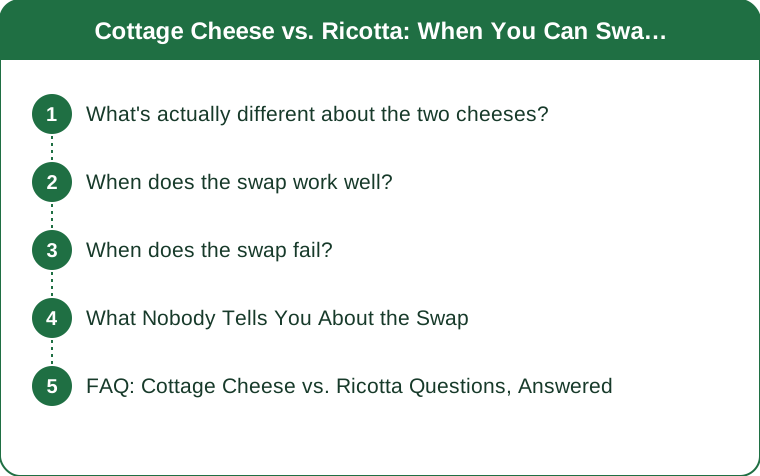
What’s actually different about the two cheeses?
Ricotta is made from whey (a byproduct of other cheesemaking) and has a drier, finer, slightly sweet curd. Cottage cheese is made from milk curds directly, with more moisture and a distinctly lumpier texture even after blending. Ricotta’s lower moisture and finer texture are why it holds shape better in delicate applications.
When does the swap work well?
Baked, high-heat dishes — lasagna, stuffed shells, baked ziti — where the dish cooks long enough to meld textures and moisture differences matter less. Blending cottage cheese smooth first (30-45 seconds in a food processor) closes most of the textural gap for these uses.

When does the swap fail?
No-cook or delicate desserts — cannoli filling, a ricotta cheesecake, a simple ricotta-and-honey spread — where cottage cheese’s higher moisture content and tangier flavor come through clearly and the texture never fully matches ricotta’s characteristic smoothness, even blended.
What Nobody Tells You About the Swap
Draining cottage cheese first (through a cheesecloth or fine strainer for 20-30 minutes) removes much of the excess moisture that causes watery lasagna or a runny filling — this single step is what separates a good swap from a mediocre one in most recipes.
FAQ: Cottage Cheese vs. Ricotta Questions, Answered
Does blended cottage cheese taste different from ricotta?
Slightly tangier and saltier, generally — most people don’t notice in a well-seasoned baked dish, but it’s more apparent in simple, lightly-seasoned preparations.
Is cottage cheese healthier than ricotta?
Cottage cheese is generally higher in protein and lower in fat per serving, making it the better swap nutritionally, not just texturally, for many home cooks.
Can I use whole-curd cottage cheese instead of small-curd for this swap?
Either works once blended smooth — small-curd blends slightly faster and more evenly, but the difference is minor after processing.
TL;DR:
- Blend cottage cheese smooth and drain excess moisture before swapping into baked dishes
- Works well in lasagna, stuffed shells, baked ziti — cooking masks remaining texture differences
- Skip the swap for no-cook desserts and delicate spreads where ricotta’s texture is the point
- Cottage cheese generally wins on protein, ricotta wins on smoothness
Keep Reading
This article is for general informational purposes only and is not medical advice. Always consult a qualified health professional for guidance specific to you.